First: agree on what counts as a shared cost
Most road-trip money arguments aren't about the math — they're about the categories. Before the first fill-up, agree on which costs go into the shared pool:
- Always shared: fuel, tolls, parking at shared destinations, and a car wash if the trip earned it.
- Usually shared: the rental car and its insurance, if you rented one.
- Never shared: personal snacks, souvenirs, and that detour one person insisted on making alone. Personal stays personal.
The gray zone is the car itself — and that's the question that deserves its own section.
Should the driver pay less?
When one friend supplies the car, they're contributing something real: depreciation, tire wear, oil, insurance risk, and hours of driving labor. Passengers who insist on a perfectly even fuel split are getting a subsidized trip. Three arrangements cover almost every situation:
- Short trip, friends: passengers cover all the fuel, driver contributes the car. Clean and widely accepted.
- Long trip: everyone — driver included — splits fuel evenly, and passengers pick up tolls and parking. The driver's contribution is the vehicle itself.
- Recurring carpool: use a per-mile rate instead of receipts. Standard mileage rates (the kind tax agencies publish) exist precisely because fuel is only about half the true cost of running a car. Our carpool & gas splitter does this math for you.
Whichever you pick, say it before the trip. "I assumed you'd cover gas since it's my car" is a terrible sentence to deploy at the last rest stop.
The pool method: settle once, not at every stop
Splitting each fill-up at the pump is how you turn a vacation into accounting homework. The better system is the pool: anyone who pays a shared cost keeps the receipt (or just notes it in the group chat), and you settle once at the end.
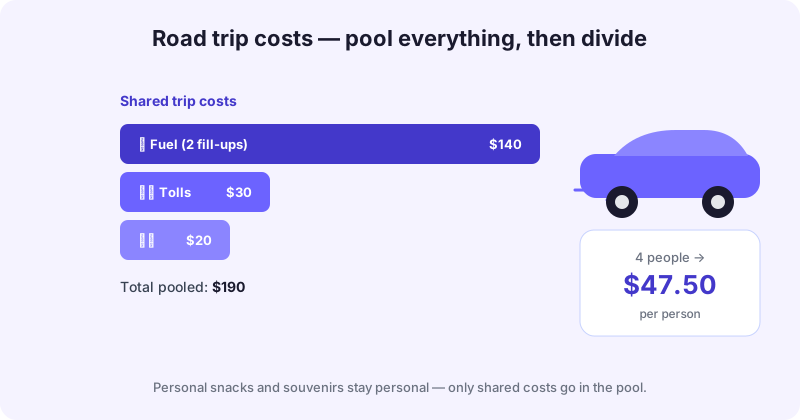
Say four friends drive to the coast and back. Fuel comes to $140 over two fill-ups (one paid by Maya, one by Jon), tolls are $30 (Maya's transponder), and parking is $20 (paid by Sam). The pool is $190, so each person's share is $47.50. Maya already paid $100 and Jon $70 — so the other two owe money, Maya is owed $52.50, and Jon is owed $22.50. One settle-up, two payments, done.
That netting step — figuring out who owes whom with the fewest payments — is exactly what Spllito's travel expense splitter automates. Enter who paid what, and it produces the minimal set of transfers.
Multi-car convoys
Two cars, seven people, different fuel economy — this is where fairness usually dies. The trick is to treat the convoy as one trip, not two: pool both cars' fuel and tolls into a single total and divide by all seven people. Splitting per-car punishes whoever ended up in the thirstier vehicle for a seating decision nobody made on purpose.
The exception: if one car takes a significantly different route or side trip, bill that leg to its occupants only.
Partial riders: the leg-by-leg rule
When someone joins halfway or gets dropped off early, split each leg separately among the people actually in the car for that leg. If the outbound fuel was $70 with four people ($17.50 each) and the return was $70 with three ($23.33 each), the person who only rode out owes $17.50 — not a quarter of the whole trip. It sounds fussy written down, but it's ten seconds of math and it's exactly fair.
Planning a bigger trip? Our group trip budget template covers lodging, food, and activities — and the free travel expense splitter settles the whole trip in one pass. No signup, works offline in the car.
When nobody drives: rideshares
City legs of a trip often happen in an Uber or Lyft instead of the car, and those fares deserve the same treatment: pool them with the other shared transport costs rather than letting whoever's phone booked the ride eat the charge. We built a dedicated Uber & Lyft cost splitter for groups that rideshare together regularly.
Frequently Asked Questions
Should the driver pay for gas on a road trip?
The most common fair arrangement: the driver contributes the car and the driving, passengers cover most or all of the fuel. For longer trips, split fuel evenly including the driver, but have passengers cover tolls and parking.
How much should I charge friends for gas money?
Total the actual fuel receipts and divide by the number of people — don't estimate. For recurring carpools, a per-mile rate (many use a standard mileage rate as a reference) fairly covers fuel plus wear and tear.
Does wear and tear on the car count as a shared cost?
For a one-off trip among friends, usually no — the passengers covering fuel is considered fair compensation. For regular carpooling, yes: use a per-mile rate instead of just splitting gas, since tires, oil, and depreciation are real costs.
How do we split costs when someone only rides part of the trip?
Split each leg separately among the people in the car for that leg. Someone riding half the distance owes roughly half a full share — leg-by-leg math handles it exactly.
What's the easiest way to settle road trip expenses?
Pool everything: whoever pays for gas, tolls, or parking notes it, then at the end run the totals through a free tool like Spllito's travel expense splitter. It nets everything into the fewest possible payments.