Why restaurant bills cause more arguments than rent
Rent is one number, split once, by people who had time to negotiate. A restaurant bill is thirty line items, split in ninety seconds, by people who are tired, slightly tipsy, and being watched by a waiting server. It's the worst possible environment for financial negotiation — which is why the group that "just splits it evenly" and the friend who "only had a salad" end up quietly resenting each other.
The fix isn't better manners. It's picking the right splitting method before the check arrives, and letting a calculator do the arithmetic. Here's how each method works and when it's the fair choice.
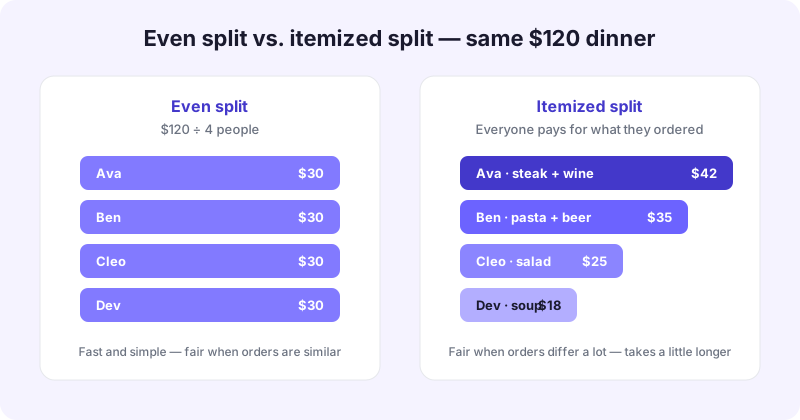
Method 1: The even split
Total ÷ people. It's fast, it feels generous, and for many groups it's genuinely the right answer. An even split is fair when:
- Orders are roughly similar. Everyone had a main and a drink in the same price range.
- You eat together often. Over ten dinners, the differences wash out. Tonight's undercharge is next month's overcharge.
- The gap is small. If the difference between the biggest and smallest order is a few dollars, itemizing costs more in goodwill than it saves in cash.
The even split fails when those conditions don't hold — and it fails in one direction. The person who ordered modestly always subsidizes the person who didn't. Do that repeatedly and the modest orderer stops coming to dinner.
Method 2: The itemized split
Everyone pays for exactly what they ordered, plus their proportional share of tax and tip. Itemizing is the fair choice when:
- Order sizes genuinely diverge — someone had the tasting menu, someone had soup.
- Alcohol is involved unevenly. Two cocktails can cost more than an entrée. Non-drinkers should never be splitting the wine.
- It's a one-off group. Colleagues, extended family, a reunion — there's no "it evens out over time" when there's no next time.
- Budgets differ. A student and a senior engineer at the same table aren't having the same financial evening. Itemizing lets each order to their own budget without penalty.
Method 3: The hybrid (what most groups actually land on)
In practice, most groups converge on a middle path: split shared items evenly, itemize individual ones. Appetizers for the table, shared dessert, and a bottle of wine that everyone drank get divided among everyone who partook. Individual mains and personal drinks stay with their owner. It captures most of the fairness of itemizing with a fraction of the arithmetic.
Don't skip the tax-and-tip math
Here's the mistake even careful groups make: they itemize the food, then split tax and tip evenly. That quietly recreates the unfairness they were trying to avoid. Tax and tip are percentages of the subtotal, so they should follow the same proportions as the food. If your order was 30% of the subtotal, you owe 30% of the tax and 30% of the tip. Our free tip calculator handles the percentage math, and the restaurant bill splitter allocates everything proportionally in one pass.
A worked example
Four friends, $120 subtotal: Ava had steak and wine ($42), Ben pasta and a beer ($35), Cleo a salad ($25), Dev soup and water ($18). Tax is $10.80 (9%) and tip $24 (20%) — $154.80 all in.
Even split: $38.70 each. Dev pays more than double his order to cover Ava's wine.
Itemized with proportional tax and tip: Ava pays $54.18, Ben $45.15, Cleo $32.25, Dev $23.22. Everyone pays exactly 129% of their own order — the same multiplier, which is the definition of fair here.
The etiquette part: one card, then settle
Whatever method you choose, the smoothest mechanics are always the same: one person pays the restaurant, and the group settles privately. Servers get one card instead of six. The table clears fast. And the splitting conversation happens over phones on the sidewalk, not across a table with a queue forming.
Two habits make this painless. First, say the method out loud when you sit down — "itemized tonight?" takes three seconds before dinner and is excruciating after. Second, settle the same night. Debts that survive the evening become debts someone has to chase.
Split tonight's bill in 60 seconds: open the free restaurant bill splitter — enter what each person ordered, add tax and tip, and share the screenshot to your group chat. No signup, works on any phone.
What about delivery orders?
Group food delivery has the same fairness problem plus fees: delivery charges, service fees, and driver tip. The same principle applies — itemize the food, split the fixed fees evenly, and allocate percentage-based fees proportionally. We built a dedicated food delivery bill splitter for exactly this, and our guide to splitting bills fairly covers the general principles that apply to every shared expense.
Frequently Asked Questions
Is it rude to ask for an itemized split at a restaurant?
No — as long as one person pays the restaurant and the group settles among themselves afterwards. What servers dislike is six separate cards; what friends dislike is subsidizing someone else's steak. Settling privately solves both.
How do you split tax and tip fairly?
Proportionally. If your food was 30% of the subtotal, you pay 30% of the tax and tip. Splitting tip evenly while itemizing food quietly overcharges the light eaters.
Should people who don't drink pay for the group's alcohol?
Generally no. Alcohol is the biggest source of bill inequality — two cocktails can cost more than an entrée. The common fix: split food evenly, itemize drinks.
What's the fastest way to split a bill with a big group?
One person pays the restaurant, then runs the split in a free tool like Spllito's restaurant bill splitter and shares a screenshot. It handles itemized, even, and hybrid splits with tax and tip in under a minute.
How do you handle shared appetizers and desserts?
Split shared items evenly among everyone who ate them, and itemize individual mains and drinks. This hybrid method is what most groups naturally settle on.